Showing posts with label Cambridge UK. Show all posts

Wednesday, July 29, 2015

Longest Guided Busway

Cambridgeshire Guided BuswayThe Cambridgeshire Guided Busway has overtaken Adelaide's O-Bahn Busway as the world's longest. On Sunday I had a trip from Cambridge, to Huntingdon via St Ives. Most people in Cambridge may not even notice the bus-way, as in the city the specially adapted buses travel on ordinary roads and use ordinary stops.

If you look closely you will see small guide wheels (about the size of a small dinner plate) next to the front wheels of the buses. These contact the edges of the bus-way to steer the buses.

You board and pay for a ride like an ordinary bus (I took a double decker bus, with an excellent view from the front seats upstairs). One complication is that there are two separate companies provideing ser sercves and their tickets are not interchangeable: if you buy a return ticket from one company you cannot travel back on the other. You can use a smart card between both services, but these have to be ordered by mail and cannot be purchased on-lboard.

The bus-way starts just outside Cambridge, where the bus leaves the normal road, goes over a car trap (a pit in the center of the roadway to stop ordinary cars driving onto the bus-way)and onto the concrete tracks. The bus-way is mostly built like a concrete railway, with two wide concrete rails (one for each side of the bus) and a raised edge for the guide wheel. There is grass growing between the rails and between the two sets of tracks. The ride is quite bumpy as the bus goes over the joins in the track and also the bus sways from side to side (more so than I remember from the Adelaide bus-way). The swaying is likely more pronounced on the top deck of a double deck bus (Adelaide has had problems with swaying of the rear of articulated buses).

The bus-way follows a disused railway track and at times goes close behind houses, with a high sound barrier on each side (which you can see over from the top deck). Out in the countryside there are wetlands on either side, with people bird watching and fishing. At one point near St Ives there is a marina at the river.

There are several stops along the way with park and ride facilities and I noted one disused railway station. Between St Ives and Huntingdon the bus travels on ordinary roads. To get the guided bus-way experience you might as well just go Cambridge to  St Ives and back.

In 2009 I traveled the 12 kilometers, of Adelaide's O-Bahn Busway which was then the world's longest. The experience in Cambridge is similar. This is not a glamorous mode of travel (like a monorail), but a pratical solution to a particualr problem: where space in confined or ground too soft or undevne for a normal roadway to be built.

The o-bhan bus guidance technology is a simple and proven mechanical system. However, technology has advanced to the point where it should be possible to achieve the same result using electronics. Using automatic lane and cruse control developed for cars and trucks, it should be possible to have buses self steer in bus lanes and keep a safe distance from each other. This should make it possible for buses with no mechanical modifications to travel on an o-bhan bus-way, as well as one on an ordinary roadway. Also it should be possible to use positioning technology and communications technology to safely share one lane for two way traffic.  This would allow, for example, just one lane to be built and passing lanes at the bus-stops. Buses would take turns to use the lane, waiting at the stops (just as trains do on many lines now). This would greatly reduce the cost of the construction of bus-ways. At peak times buses could travel in convoys, with each automatically separated by a safe distance.

Monday, July 27, 2015

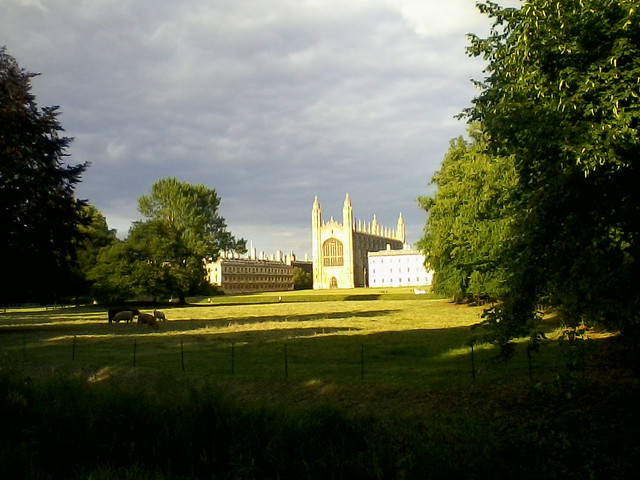
From the Backs at Cambridge

Chapel of King's College CambridgeI don't think it is possible to take a bad photo of the Chapel of King's College Cambridge. Here is one I took yesterday, almost at random (I took a photo from almost the same spot about 20 years ago).

Sunday, July 26, 2015

Romeo and Juliet in St John’s College Gardens Cambridge University

The Cambridge Shakespeare Festival, runs until 29 August. Yesterday I attended the afternoon performance of  from Romeo and Juliet in St John’s College Gardens. The best part of this was the setting in the gardens, at the "backs" of Cambridge University. This is the open area across the river Cam from the city. We arrived to the performers doing warm up exercise and a wandering ministerial. As well as seating there was the option of a picnic on the lawn.

The performers had the challenge of projecting their voices in the open air, without the benefit of a stage and competing with aircraft and traffic noise. Some were not up to the challenge. Juliet was a little old for the part, but made up with girlish enthusiasm.

Saturday, July 25, 2015

From a Cambridge College Room

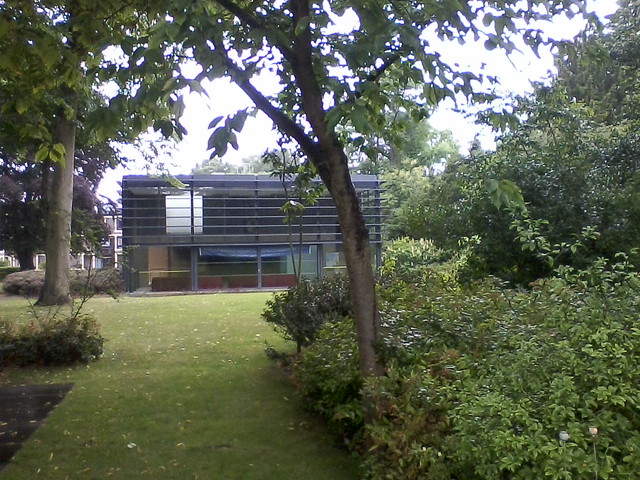
Fitzwilliam College Cambridge AuditoriumGreetings from Fitzwilliam College, Cambridge University (UK), where I have been attending the 10th International Conference on Computer Science and  Education (ICCSE 2015). Most of the other delegates left yesterday and the quad is quiet. Fitzwilliam ("Ftiz") has modern buildings (with plumbing), but retains a modest scale and has quiet quad.

The auditorium used for the conference is only the hight of a two story building, but extends another two stories underground. Like the conference room at Hong Kong Open University (where I attended ICOFE2015), the auditorium also doubles as a basketball court.

Apart from the gardens, the best part of Fitz was the helpful Porter and the barman. The service is understated. Unlike a hotel, when I arrived I did not need to show my passport, provide a credit card deposit and fill in a form. I gave my name, signed in and d was handed a key. Unfortunately, the food was not so good (the baked beans of an English breakfast can be hard to face in the morning). However, the WiFi was excellent (apparently University of Cambridge had suffered a major network outage the day before, but it worked flawlessly during my stay).

You do not have to be alumni or attending a conference to get the university college experience. The service I booked through, Universityrooms.com, has rooms around the world. But keep in mind that during semester times there may be few rooms available, and during the breaks conferences make block bookings.


ps: There is a performance of Romeo and Juliette to attend at St. Johns. 

Thursday, July 23, 2015

Vertical Replenishment of Chinese Aircraft Carrier Using Robot Helicopter

Greetings from the 10th International Conference on Computer Science and  Education (ICCSE 2015) in Cambridge (UK), where Ben M. Chen from the UAV Research Group at the National University of Singapore is speaking on "Unmanned Systems Research and Education". He showed a video of a competition in China, where the UAV helicopter had to pick up a load from one moving platform and transfer it to another moving platform. What got my attention was that this was intended to simulate the transfer of material from a supply ship to an aircraft carrier. This vertical replenishment (VERTREP) application is one still carried out with pilot operated helicopters in most navies. His paper "Development of an Unmanned Helicopter for Vertical Replenishment" provides details. It would be interesting to know the view of Australia about Singapore assisting China with its ability to project naval power.

Computers for clean drinking water

Greetings from Fitzwilliam College, Cambridge University (UK), where the 10th International Conference on Computer Science and  Education (ICCSE 2015) just opened. The keynote is by Professor Clarence W. de Silva, British Columbia University, on "Sensing Issues in the Automated Monitoring of the Quality of Drinking Water". Professor de Silva pointed out the importance of clean drinking water and water for agriculture. He pointed out that the USA has to purchase water from Canada. Monitoring the quality of water manually is time-consuming and there can be long delays, resulting in the consumer receiving polluted water. Computers can be used to monitor the water in real time and issue warnings, including to smart phones.Interestingly the same system can be used to detect earthquakes, by changes in water quality as well as by incorporating accelerometers.

Later I will be speaking on "Merging Synchronous and Asynchronous Techniques for E-Learning".

Friday, March 20, 2015

Cambridge Phenomenon's Fifty Years of Innovation

Greetings from the UNSW Campbelltown Library. Seeking more content for my innovation course, I have tracked down the only copy of Kirk, Cotton and Gates (2012) in an Australian public library. In doing so I feel I am back on a journey started twenty years ago. In 1996 I spent several sessions in the ANU library, reading one of the few copies of the report "The Cambridge Phenomenon" (Segal Quince & Partners, 1985) in Australia. I very much had the sense I was holding a precious commodity to which I had limited access. I made extensive notes, appropriately enough on a Cambridge Z88 portable computer. These notes became Appendix A "The Cambridge Phenomenon - Summary of the Report" in Worthington (1999). I have had to drive three hours to read the sequel: I hope it is worth it.

The new the book is much glossier than the original.  The forward is by Bill Gates (There is a Microsoft Research Lab at Cambridge, adjacent to the new Cambridge University Computer Lab). The preface is by Charles Cotton, founder of Cambridge Phenomenon Limited (which appears to have been set up just to write this book) and mentions the Hauser Forum (in the West Cambridge Research and Development Park).

There is a two page diagram "Cambridge Ideas Change the World" which is also available on-line as a PDF document. This takes some liberties with history to place Cambridge at the center of developments in Genomics, Monoclonal Antibodies, Computing and Software. As an example, the Computing time line starts with Charles Babbage and his Difference Engine in the 1800s (was this done at Cambridge?), then Alan Turing before getting on to firmer ground with the 1946 EDSAC computer which was built at Cambridge. The last step in this is the formation of ARM at Cambridge in the 1990s (I visited there a few years after the company was formed and wish I had bought some shares).

The introduction of the book is on firmer ground starting with Tim Eiloart founding Cambridge Consultants in 1960. The authors estimate that 4,000 technology companies have been set up around Cambridge since the 1960s, with 1,400 in 2012 and 48,000 employees.

The chapter on the early days acknowledges Cambridge Scientific Instrument Company, found by Horace Darwin in 1881 to make precision instruments, but it was not until the 1960 that conditions were right to make such companies more than a rarity.

The next chapter "Growing Pains: 1970 - 1979" covers Sinclair Radionics, which made the Sinclair Executive calculator, Also Arcorn Computers Ltd. The Mott Report (1969) lead to the Trinity Science Park. The Bolton Report (1971) resulted in government policies to encourage "small Firms".

The authors attribute Matthew Bullock at Barclays Bank in Cambridge with discovering a "triangle of activity between the river, Bridge Street and Jesus Lane" (Kirk, Cotton & Gates, 2012, p. 44). However, looking at a map of Cambridge, I am not sure where this triangle is. Bullock with Jack Lang of Topexpress (one of the companies in the triangle) then invited staff of the other companies to meet informally.

Kirk, Cotton & Gates (2012, p. 45) describe how some of these staff had been students and staff at the Cambridge University Computer Lab and meetings in the Eagle pub acted as a replacement for previous university common room discussions. Outcomes included changes to planning laws to allow R&D functions in commercial, rather than industrial, premises. Bullock identified Cambridge as an area for Barclays to invest in due to improved transport combined with the industry startups.

The next chapter "Putting the Phenomenon on the Map: 1960-1989" starts with a brief description of the first Cambridge phenomenon report (Segal Quince & Partners, 1985). Given that the later work has a name very similar to the first, this work gets remarkably little acknowledgement or analysis. I had assumed that the new report was by some of the same authors, or the same consulting company, or by people in some way associated with the first, but I could find no connection in the text. There appear to be just five paragraphs in this chapter of a book of 244 pages summarizing the previous study. The rest of the chapter describes the rise of various companies, most notably Acorn Computers making the BBC Microcomputer. The chapter ends by discussing the slow start for the Trinity Science Park.

Strangely the next chapter "Momentum: 1990-1999" has a large photo of the Cambridge Judge Business School, with no explanation of what this has to do with technology startup companies (p.66). I recall seeing this building in Trumpington Street on my way to talk to  Andy Hopper at the the much more modest Olivetti Research Laboratory (ORL) in 1996. After reading the original Cambridge Phenomenon I had set out to see what it was all about in person.

At this point, about one quarter of the way through, I lost interest in the book and went for lunch at the UWS Cafe. After a lunch of fish and noodles I came back to the library to consider what I had read. The remainder of the book appeared to be the same detailed catalog of companies and funders as before. What was lacking was an analytical analysis of the reasons for this development which was in the original report.

This is not an updating of the original report, more catalog of what happened later. I suggest anyone interested in the how and why of tech startups should read the original report. You can then read 2012) which gives a good summary of the second report.

The Canberra Start-up Business Boomerang

Is there anything from this book for my innovation course? Not really. The idea of an informal way for people from different startup firms to meet is useful. The concept of new companies starting in a small area in proximity to a university is not new, but worth restating.

Such an area is now forming in Canberra, on the western edge of the ANU campus and has been referred to as the "Canberra Innovation Precinct". However, the area is now expanding to cover much of the western side of Canberra's CBD. Given the shape of this precinct, it could be called the "Canberra Start-up Business Boomerang": from Marcus Clarke Street extending east to London Circuit, and from Barry Drive in the north to Gordon Street in the south. At the center of this, both geographically and strategically, is the Canberra Innovation Network (CBRIN). Also it should be noted that this is not far from where the Griffins' first plan for Canberra (1912), had marked as the location for the "Technology" building of the national university.

The Wig and Pen Bar, which was across the road from CBRIN, and serves as the equivalent of the Eagle pub in Cambridge, has moved slightly further away to the foyer of the ANU Music School.

Other Works on the Cambridge Phenomenon


A Google Scholar search finds more than one million references to the "Cambridge phenomenon". Miao and Hall (2014) look at the more ‘cultivated’ Chinese science parks, as a contrast to Cambridge.
Moog (2002) comments "Knowledge intensive new firms often result from high educated, academic founders or directly from academic institutions".
WESTHEAD (1988) points out that the phenomenon of closely clustered high tech firms may not be able to be replicated. may not be replicated. Benneworth and Groen (2010) describe how more formal university entrepreneurship programmes, which grew up partly as a response to the Cambridge Phenomenon, act as gateway to wider entrepreneurship system outside the university.
Yuehua. (2002) concludes that developed countries' experience of science parks is applicable to developing countries.

Garnsey, Lorenzoni and Ferriani (2007), detail the formation of ARM, as a spin-off of Acorn Computers. Ahmed (2013, pp. 122-139) has a useful chapter on "Entrepreneurs, Spinning Out, Making Money andLinking with Industry", with case studies on Shape Data Ltd, Acorn/ARM, Sintefex Audio, Bango,, RealVNC, Sophos plc, Jagex, blinkx, Camrivox,  Green Custard, The Raspberry Pi Foundation XenSource and Rapportive. Also there is a section on how the computer lab supported these developments. Unfortunately this 179 page e-book has very high resolution color images which makes it a 9.5mbuyte download (a version with smaller images would be more useful for students).


Curiously some of these works cite my own summary of the "Cambridge phenomenon" (Worthington, 1999), rather than, or in addition to, the original report. Livesey, Sullivan, Hughes, Valli, and Minshall (2008) in a Cambridge University Economics and Policy Working Paper quote me accusing the the Australian government of believing “if a
high technology/ science park is created, with suitably high-tech buildings, then high
technology firms will be attracted to move in from somewhere.”

References

Ahmed, H. (2013). Cambridge Computing: The First 75 Years. Retrieved from http://www.cl.cam.ac.uk/downloads/books/CambridgeComputing_Ahmed.pdf
Benneworth, P., & Groen, A. (2010). " No longer the sparkling new idea": anchoring university entrepreneurship programmes in academic, entrepreneurial and regional policy networks. Retrieved from http://doc.utwente.nl/73396/1/Benneworth.pdf

. (2012). Viewpoint: The Cambridge Phenomenon, five decades of success. BBC News UK. Retrieved from http://www.bbc.com/news/technology-17982595

Garnsey, E., Lorenzoni, G., & Ferriani, S. (2007)Speciation through Entrepreneurial Spin-off: The Acorn-ARM story. Retrieved from http://www.researchgate.net/profile/Elizabeth_Garnsey/publication/222423713_Speciation_through_entrepreneurial_spin-off_The_Acorn-ARM_story/links/0deec52945dd7279bf000000.pdf
 
Kirk, Kate & Cotton, Charles & Gates, Bill, 1955- (2012). The Cambridge Phenomenon : 50 years of innovation and enterprise. Third Millenium, London

Livesey, F., O’Sullivan, E., Hughes, J., Valli, R., & Minshall, T. (2008). A pilot study on the emergence of university-level innovation policy in the UK. Centre for Economics and Policy Working Papers. Retrieved from http://www.ifm.eng.cam.ac.uk/uploads/Research/CIG/UniversityInnovationStrategy_FinalReport_RELEASE_140308.pdf

Miao, J. T., & Hall, P. (2014). Optical illusion? The growth and development of the Optics Valley of China. Environment and Planning C: Government and Policy, 32(5), 863-879. Retrieved from http://eprints.gla.ac.uk/98479/1/98479.pdf

Moog, P. (2002). Human capital and its influence on entrepreneurial success. Historical Social Research/Historische Sozialforschung, 157-180. Retrieved from http://www.ssoar.info/ssoar/bitstream/handle/document/3395/ssoar-hsr-2002-no_4__no_102-moog-human_capital_and_its_influence.pdf?sequence=1


Segal Quince & Partners (1985). The Cambridge phenomenon : the growth of high technology industry in a university town. Segal Quince & Partners, Cambridge

Trani, E. P., & Holsworth, R. D. (2010). The indispensable university: Higher education, economic development, and the knowledge economy. R&L Education.
WESTHEAD, D. P. (1988). SWP 30/88 NEW MANUFACTURING FIRMS AND NEW FIRM FOUNDERS IN WALES, 1979-1985. Retrieved from https://dspace.lib.cranfield.ac.uk/bitstream/1826/576/2/SWP3088.pdf

Worthington, Tom (1999). Net traveller : exploring the networked nation (Ed. 1.0). Australian Computer Society, Dickson, A.C.T Retrieved from http://tomw.net.au/nt/
Yuehua, Z. (2002). A developing economy oriented model for science park management. Retrieved from http://ro.uow.edu.au/cgi/viewcontent.cgi?article=1989&context=theses

Tuesday, July 03, 2012

Augmented Reality Research at Microsoft Research Cambridge

Greetings from the Australian National University in Canberra, where Dr Shahram Izadi, from the Computer Mediated Living group at Microsoft Research Cambridge, UK is describing research on augmented reality.

After showing some early work on experimental 3D sensors, Dr Izadi concentrated on use of the Microsoft Kinect device. He pointed out that this hardware is not a real 3d sensor and it needs software enhancement to extract 3d data from the camera. He provided a fascinating live demonstration of the process (at one stage I looked up and found that myself and my laptop had been scanned).

The important point of the demonstration is that a relatively low cost sensor can be made to do far more with sophisticated software. It will be interesting to see what non-game applications may be developed.

New research is using two digital camera to provide depth data, which would have advantages over the current Kinect device. This could work outdoors and work in a small hand-held device (such as a mobile phone, tablet, or a pair of glasses).

At the end of the talk Dr Izadi mentioned collaboration with researchers in other fields. But it struck me that the examples given were all very scientific and technical (such as design of 3D objects and enhancing surgery). It struck me that input from performers and artists could be fruitful. As an example, Dr Izadi is a very entertaining presenter, with good use of gestures and movement, but he then has to become very static in order to operate the presentation on his laptop. Providing a gesture interface for Microsoft Powerpoint, using the Kinect (or a web camera), would seem an interesting area for research, as well as a potentially popular commercial product. In its simplest form as standard set of gestures, which the presenter has to learn could be used. A more sophisticated approach would have the software learn the presenter's natural gestures.

As well as the familiar Research Labs in the USA, UK, India and China, Microsoft has also established Advanced Technology Labs (ATL) at Cairo, Europe and Israel. The ATLs are focused more on joint work with local organizations and product development, whereas the research labs have carried out long term research on their own. Some years ago I visited Microsoft Research Cambridge and found it a little insular.
Experiencing computing in magical ways.
Dr Shahram Izadi (Computer Mediated Living group at Microsoft Research Cambridge, UK)
COMPUTER SCIENCE SEMINAR
Information and Human-Centred Computing

DATE: 2012-07-03
TIME: 16:30:00 - 17:30:00
LOCATION: RSISE Seminar Room, ground floor, building 115, cnr. North and Daley Roads, ANU
CONTACT: hongdong.li@anu.edu.au

ABSTRACT:
Dr Shahram Izadi will present some of his recent work - see his Bio below for a richer description.
BIO:
Dr Shahram Izadi is a research scientist within the Computer Mediated Living group at Microsoft Research Cambridge. He co-leads the Interactive 3D Technologies (i3D) sub-group, and holds a visiting professorship in the Virtual Environments and Computer Graphics group at University College London (UCL). He describes his work as: aMashing together exotic sensing and display hardware with signal processing, vision and graphics algorithms to create new interactive systems, which enable users to experiences computing in magical waysa. Some of his most notable projects and publications to date include: KinectFusion; Mouse 2.0; SecondLight; and ThinSight. Shahram has been at Microsoft Research since 2005 and prior to that spent time at Xerox PARC. He received a TR35 award in 2009 and was nominated one of the Microsoft Next in 2012. He lives in Cambridge, UK, with his wife and daughter.

Monday, July 02, 2012

Preparing Postgraduate Students

The Preparing for Academic Practice website is provided by Centre for Excellence in Preparing for Academic Practice at Oxford University for graduate students. This is intended for research students, in particular those undertaking a PHD, but would also be of use for postgraduate coursework students.

The material is drawn from studies at several UK universities. Unfortunately, as a result it lacks cohesion. As an example, if I click on "Being an international PhD researcher" I would expect to be taken to a web page on that topic, but instead get one asking me to choose from the universities of Warwick or Oxford. The Warwick link goes to "What to expect from your PhD" and the Oxford link goes to "Diversities in Transnational Experience".
  1. Becoming a PhD researcher
  2. Being an international PhD researcher
  3. Getting through your PhD
  4. Venturing into teaching
  5. Academic career paths
  6. From Practice to Academia
  7. Access for trainers & developers
  8. research projects
  9. About this web site

Monday, October 18, 2010

Open e-Learning Course on Open e-Learning

As mentioned previously, the UK's Open University is now providing free online course materials under a open access licence. One lack in online learning has been the scarcity of course on how to create and run online courses (train the trainer). OU has some which would be relevant: Creating open educational resources, Accessibility of eLearning, Repurposing Open Educational Content, Developing good academic practices and Learning, thinking and doing. Add a few more and this might be enough material for a full 12 week university course.

Thursday, October 14, 2010

Open University Courses

The UK's Open University is now providing online course materials under a Creative Commons Attribution-NonCommercial-ShareAlike 2.0 Licence. After trying for much of the day to register with OU ( and getting "Unable to process your request at the moment, please try again later.") at 9:30pm I was able to get into the system. What I see is a Moodle based learning management system, which has been carefully skinned with an elegant OU style.

Some of the courses I would like to investigate are Creating open educational resources, Accessibility of eLearning, and Repurposing Open Educational Content.

Open University Open Access Courses

The UK's Open University is now providing online course materials under a Creative Commons Attribution-NonCommercial-ShareAlike 2.0 Licence. This allows the material to be used for free, changed and the changes distributed, as long as the original author is acknowledged and copies are not sold.

The OU's materials look comfortably familiar. As an example for "Environmental factors and organisations", a 6 hour course, with about ten pages of notes. As well as bring provided as a set of web pages formatted like an electronic book, there is also a printable version of the notes, all on one web page.

OU appear to be using Moodle 2 and perhaps the Moodle Book module, to produce these notes. This is similar to the book format I use for my Green ICT course. The quantity of notes OU is providing is similar to that for my course (about 1.5 pages of notes per hour of course).

Unfortunately I was unable to see what the actual OU Moodle based courses look like, as when I attempt to register I get: "Unable to process your request at the moment, please try again later.". Perhaps OU need to carry out some optimisations of their Moodle system (a few tweaks can make the system much more efficient).

Saturday, December 05, 2009

Cambridge University Online Courses

After suggesting to my colleagues at the Australian National University School of Computer Science (SoCS) we use an e-Oxbridge educational model, I thought I should check to see how Oxford andr Cambridge apply e-learning. A quick web search found the Cambridge University Institute of Continuing Education, which offers online courses specialising in adult and non-traditional learners. The Institute clims: "unparalleled level of online support and direction from experienced and enthusiastic tutors", whichfits with the Oxbridge model of education. However, these are short general interest and proessional devlopment courses, not full degree programs.

An example is "The global climate challenge: policy technology and the future" (COV007), an 11 week course costing £165.00 and offering 10 credits at level 4 of the Framework for higher education qualifications. The award requires participation in online discussions, a Personal Statement of Learning (e-Portfolio) and assignments. Six such courses would be required for an undergraduate "Certificate of Continuing Education" (Postgraduate courses are at FHEQ Level 7).

Sunday, April 26, 2009

Cambridgeshire Guided Busway

The Cambridgeshire Guided Busway (UK), when completed in late 2009, will be the longest guided bus system in the world. It will use similar technology to the Adelaide O-Bahn Busway, which is currently the world's longest. The guided busways combines the features of a bus and tram. A concrete track is being laid, mostly along the right of way of the disused Cambridge and Huntingdon railway. Small wheels on new buses will allow them to be guided on the track, but also run on ordinary roads between sections of track. This has advantages over a tram, which can only run on track, not ordinary roads. The use of the guideway allows for two tracks (one in each direction) to be laid in a smaller space than a roaidway. However, the system has disadvantages: busses have internal combustion engines (not electrically powered as with most trams) and so create local pollution and then have a lower carrying capacity than multi unit trams.

I have attempted to map the route of the bussway. Note that the route is only approximate and the timings are incorrect (these are based on Google maps estimate of walking speed). Also I attempted to use Googles "my maps" feature, but could not work out how to import the directions.:

View Larger Map

Saturday, April 25, 2009

What to see in Cambridge

The University of Cambridge (England) has invited graduates of the Australian National Unviersity to visit Cambridge in July to help celebrate the 800th Anniversary of the university. There is a week's program of talks and events organised at Madingley Hall, home of the Institute of Continuing Education, which has a garden by 'Capability' Brown), but I thought I would suggest a few of my own, based on a couple of visits to the Unviersity and its environs.

The first tip is to take with you, borrow or hire a bicycle (the basement of Kings College has some bicycles which look like they were forgotten a hundred years ago). I took my own folding bicycle on one visit and found it a very practical way to get around the city centre. There are bicycle paths by the river and some of the one way streets have a bicycle lane in the reverse direction.

There is an excellent double-decker tour which covers the inner city and also gets out to the countryside around Cambridge. The locals frown on this sort of tourism, so best to quietly go off and do it by yourself. One place the tour stops is the Cambridge American Cemetery and Memorial at Madingley.

A walk along the banks of the River Cam at dusk is a must. Time it right and you can see the choir crossing the bridge to King's College Chapel for evensong at dusk (also worth attending). A punt on the river is entertaining, but the river gets crowded with tourists, so if possible get an invitation to use a college punt from their own private lawns instead of the tourist punts.

The Cambridge University Press Bookshop is worth an half hour browse. There are numerous research organisations and companies clustered around the university facilitates. Do some research before you go and get an invitation to visit. Microsoft's research institute was interesting, but you need and invitation.

Lunch or dinner at "high table" is entertaining (skip breakfast it is not very good in the average college). The high table is where the college elite and guests sit, a few cm above everyone else. Just be careful to sit where you are told and be ready to explain what you do and be able to drop some names. Trinity College puts on a good lunch and King's College was good for dinner.

The Cambridgeshire Guided Busway has not yet opened (so Adelaide's O-Bahn Busway is still the world's longest) but you can take a ride on the test buses.

By the way if you aren't an ANU alumni, but have some academic connections, you may be able to talk your way into the colleges. Just look for someone you know, who knows someone at Cambridge. I found that with a Linked in search there were 111 people I was connected with, who were Cambridge graduates, 12 of whom live within 40 km of the university and 3 who work or research at it. Also keep in mind that the university is just a loose consortium of colleges, who are always looking for guest speakers from faraway places. Even if one will not let you in the door, another may well. Once I had one introduction, I found that opened other doors.

Friday, August 22, 2008

Microsoft Research on Energy-Efficient Computing

Microsoft is supporting research into Energy-Efficient Computing. I came accross this recently when a collogigue mentioned they had attedned a attended a symposium on Sustainable Design-Make-Serve at Microsoft Research Cambridge.

REDMOND, Wash. — April 28, 2008 — As part of its Sustainable Computing Program, Microsoft Corp. today announced it will support four academic research projects focused on energy efficiency in computing in the areas of datacenter power efficiency, power management and the creation of parallel computing architecture with decreased power demands. ...

The Sustainable Computing Program explores two main areas of research that can have a major impact. The first is the principle of “pay for play,” which is the idea that the power consumed by a computing device should be proportional to the demand placed upon it, lowering the amount of energy consumed at low load and idle. Secondly, energy efficiency, even at peak loads, is equally important in reducing the overall consumption of electricity and should be managed as a first-class resource. The program encourages researchers to use novel approaches in hardware design, software, networking, benchmarking, analysis, virtualization and any other avenue that might provide improvements in the field.

Under the program, a total of $500,000 will be awarded among the four winners. A summary of the winners and descriptions of their projects follows:

“Control-Theoretic Power and Performance Management for Green Data Centers”; University of Tennessee; aimed at developing frameworks for integrating power and performance improvements in virtualized datacenters

“Building a Building-scale Power Analysis Infrastructure”; Stanford University; for the design and deployment of a dense sensor network for power analysis, producing data for future research on power-aware computing

“A Synergistic Approach to Adaptive Power Management”; Harvard University; for the development of a dynamic runtime environment that ensures that power consumption is proportional to the computational demands made on the system

“Simulating Low Power x86 Architectures with Sooner, a Phoenix-based Simulation Framework”; University of Oklahoma; for the development of a simulation framework that supports the study of low-power microarchitectures for innovative multicore systems

Microsoft Research is committed to delivering breakthrough innovations in research in the areas of energy efficiency and conservation, weather study and prediction, air pollution and quality, climate change, and hydrology. Other efforts range from sensor networks to assist scientists in understanding global ecological issues by tracking animals, to Web-enabled sensors that could be used in businesses and homes to monitor energy consumption. For example, research with the Berkeley Water Center, Lawrence Berkeley National Laboratory and National Marine Fisheries Service will use these technologies to help form a “digital” picture of watershed health. ...

From: Microsoft Research Supports Exploration Into Energy-Efficient Computing, April 28, 2008

Tuesday, April 17, 2007

Information Retrieval at Microsoft Research Labs

Recommended: Nick Craswell is speaking on Information Retrieval (Web IR) in Canberra Wednesday (I visited Nick at Microsoft Research Labs Cambridge, on a bicycle tour of Europe):
The Australian National University
DCS SEMINAR SERIES

Nick Craswell Challenges in Web Information Retrieval (Web IR)
Nick Craswell (Microsoft Research Labs, Cambridge, UK)

DATE: 2007-04-18 TIME: 16:00:00 - 17:00:00 LOCATION: CSIRO Seminar Room S206 (come to reception on Level 2, CS&IT Bldg)

ABSTRACT: When building a Web search engine, we can benefit from core IR techniques, such as probabilistic ranking models and evaluation methods. But we also face problems that are not yet so well-studied in the field of IR. This talk explores several of these. For efficiency reasons, we need to crawl the web selectively. This raises an interesting query-independent ranking problem. We have large-scale logs of user behavior. I will present a novel approach for dealing with sparsity of this data. We may also have relevance judgments for a large number of queries, as in the new TREC "million query" track, which allows for large-scale parameter tuning experiments. Each of these problems lends itself to data-driven solutions. The talk should thus give a favour of the work that goes on in the area of commercial Web IR.

BIO: Nick is a PhD graduate from ANU Computer Science who worked in CSIRO's Enterprise Search group before joining Microsoft Research in Cambridge. Nick is now employed as a researcher in the team behind Microsoft's Live.com search engine. He is a coordinator of the TREC Enterprise Track and the INEX Entities Track. He is also a Senior Reviewer for the ACM SIGIR Conference and is author of many influential and highly cited papers in the Information Retrieval area.